

When your brand is in chaos you need to make good communications decisions.
An interview with Jeff Ansell about what you need to do.
Hosted by design firm Shikatani Lacroix. www.sldesignlounge.com

Asking "What's the right thing to do":
Brings clarity to a crisis situation and leads us back to our values.
Learn more of what Jeff Ansell calls the VALUE COMPASS in his book, When the Headline Is YOU.


The message you create, the actions you take, and the comments you offer to the public during a crisis must truly be responsive, and they must truly reflect your VALUE COMPASS.
Acknowledge the concerns of the other side.
Accept responsibility.
Admit your mistakes.
Act in a trustworthy fashion.
It will help you build and rebuild long term relationships.
Use a crisis to show the public and your stakeholders what you're made of.

When The Headline Is YOU - a new book by Jeff Ansell.
"When The Headline Is YOU" is the best book I've read on how to ensure every press interaction results in fair and balanced coverage for you and your company." Greg Pruett, senior vice president, Corporate Affairs, PG & E Corporation.


Today, news reporters are forced to do research on the run, which means they're writing history in a hurray. Unfortunately, that history could be about YOU!
National Farm Animal Care Council presentation

Jeff Ansell - Make a point of pausing ...
When somebody says something to you, let there be a big pause.
Sometimes we're so quick to jump back that the person's isn't even finished what they're saying and already we're coming back.
We're listening to them speak, and thinking, "How am I going to answer? How am I going to answer?" and we're not listening to them.
If we do this to our spouses, our loved ones, the people we claim to care about, we're short-changing that relationship. But when you're involved in an encounter with somebody and you make them more important than you, you're connecting, and it's liberating.
Don't be so quick to jump in with an answer, or a comment.
You've got to make peace with pausing.

Provide compelling reasons to be trusted
Let me share a couple of ways to build trust.
First, acknowledge the skepticism other people may have about your policies, programs, initiatives, issues, and so on.
Do not pretend skepticism does not exist.
Address it, and deal with it.
Something tragic happened in Toronto recently at York University. Two young women were sexually assaulted in their dorm, and the spokesman for York University spoke to the media the next day and said, and I quote,
"The dorms are safe."
Now . . . given the sexual assaults that took place in the dormitory, how could he have possibly made such a statement?
Acknowledge the skepticism that some people feel.
For example; "As safe as we do to make the dorms, this tragedy unfolded. This horrible event took place and we will work closely with authorities to find out what we can do to keep such a terrible thing from happening again."
Put it into context and acknowledge and recognize the emotion. When you're dealing with angry people and you want to build trust and influence, you've got to tap into the emotion.
Let me give you another example of providing compelling reasons to be trusted. For a variety of reasons, the Catholic Church has not done a terribly effective job representing itself regarding scandals. There's not just one organization that speaks for the Catholic Church in North America. Everybody's on their own with all these different Archdioceses, but I will always remember the words of a parish priest in Boston. His name is Father James Flavin. He said to Newsweek Magazine, at the height of this whole scandal involving sexual abuse of young people at the hands of priests, "I wouldn't trust a priest either right now," adding, "The church screwed up royally."
I trust him. He said what everybody knows to be true but we're all afraid to say it for goodness sake.
When you acknowledge skepticism, you're simply acknowledging what everybody often knows to be true. As a result, your credibility is maintained and maybe even enhanced.

There's famous research from the University of California in Los Angeles, from "Dr. Albert Morabian."
Dr. Morabian has demonstrated conclusively that when you say something, 55% of the way your message is interpreted comes from the way you use your body and how you use your face when you say it.
38% of the interpretation of your message comes from the voice, tone, texture, and level of conviction.
So . . . run the numbers, and what does that leave?
A massive 7% for people to interpret your message based on your words.
It's disheartening.
When we speak, we have to juggle the visual, vocal, and verbal so that we can look like we mean what we say and say what we mean.
The whole secret to being a good speaker is;
"Say it like you mean it . . .
and look like you mean it."
Once a word leaves your lips, it's on its way to Mars.
It doesn't disappear.
It reverberates.
It ripples.
When we were kids we'd get into a fight in the schoolyard. We'd get a punch in the stomach and double over a little bit, but ten minutes later you'd forget about it. The pain goes away.
But, if you're a child, and somebody says something to you, like, "Her sister's the pretty one, his brother's the smart one," the comment can be forty, fifty, or sixty years old and those ugly words still live on in the universe.
We have a responsibility to use words in a responsible fashion.
Having the ability to use words is sacred. It's a gift, but we use our words in such mischievous ways, and we demean other people when we don't think about what we say.
It's a terrible thing to demean or embarrass another human being. It's an act of theft. You're stealing a person's dignity and esteem. You have no right to do that.
We should use our words to build others up. Help them feel good about themselves. Lift them up.
Think of the words that leave your lips.
It's a bit like toothpaste.
Once you squeeze it ...
it doesn't go back in.


Jeff Ansell, media trainer, talks about his experiences tracking down Nazi war criminals when he was an investigative reporter.
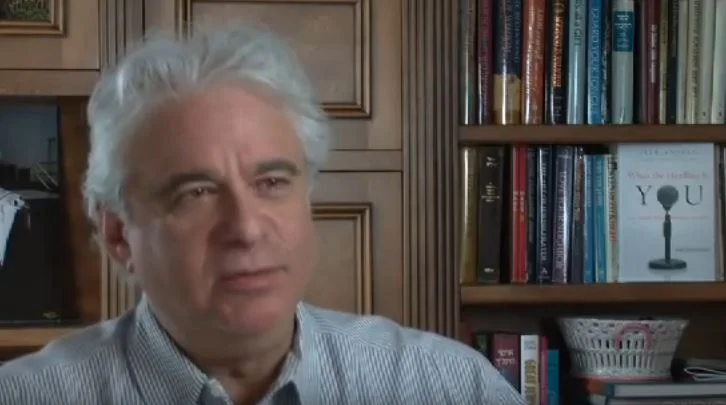
Jeff Ansell tells a story about how, when he was a teen, he met Earl Jive, a radio jock in Montreal.


In my early radio days I worked with Dick Smythe and Jay Nelson.
Jay used to pop into our studio to test his jokes on us, which often angered Dick because he was trying to work.
One day, Dick picked up a typewriter and threw it at him. It broke into a hundred pieces.
In retrospect it seems funny now, but at the time, not so much.

In a time of crisis one of the biggest mistakes spokespeople make is to think that if they just tell people the facts, everyone will understand their perspective.
I help teach a course at Harvard Law School twice a year called Dealing With An Angry Public. We get people that represent the ugliest sectors possible, like Nuclear energy, the gun lobby, tobacco, etc., - everybody you love to hate takes this course.
Invariably, someone will say, the reason we're here is because we want to help our angry public learn how to strip away emotion so they focus only on fact.
What they don't know until they finish our course is that in a battle of fact verses emotion, EMOTION IS ALWAYS GOING TO WIN.
If the protagonist in the story doesn't acknowledge emotion, the story will move from page 10 to page 5 to page 3 and to page 1 above the fold when the emotion is shoved down their throat.
Emotion is like a tidal wave.
You either embrace it or you get swallowed up by it.

When I was seventeen, and working in a factory, every day from work I used to call a different radio station to try and book an audition.
I always asked for the owner. One day I managed to get an audition at CFMB, but only after promising the owner, Casimir Stanczykowski that I'd quit bothering him if he agreed to see me.
He asked how old I was, and I lied and said nineteen.
I had to borrow a suit from a friend for the interview, but it paid off because the day after the audition I got the job.

I was terrified the first time I was on the radio. I remember that day.
I would have never attained the success and happiness I have today without the support of my family.

I worked the overnight shift at CFCF in Montreal and wanted to get off of it in the worst way. I was grateful to have a job, but after a year or so of not ever seeing the sun I wanted a normal life.
After a few years of the night shift I got a phone call from Brian Thomas who was the News Director at CHUM FM. He invited me to come for an audition in Toronto.
I got the CHUM FM job, and after I while I switched to the AM side where I fulfilled my dream of working with Dick Smythe.


Ed Schreyer, who was the current Governor General of Canada, invited Jeff and his wife Annie to Rideau Hall for dinner. Jeff is a recipient of the Governor General's Award.
While there, the previous GG, Roland Michener, who was also in attendance with his wife, took Jeff and Annie on a tour of Rideau Hall, Michener's former residence. Jeff recounts the experience in this video.

Jeff talks about his first love being radio, and how he used to listen to the big old radio in his parent's bedroom on Sunday night when he was a kid while the rest of his family watched Ed Sullivan and Bonanza on TV in the living room.

Journalism is a 24/7 business. Quite often a passionate reporter works on their own time and dime.
When a tip comes in you don't say, let me get back to you Monday morning. You follow up on Saturday night before it goes cold.
Many people think reporters are callous and calculating, and some are, but most have feelings. Good journalists learn to appropriately manage their emotions. Bad ones become almost sociopathic.
Many investigations I worked on affected me in a deep and profound way. It changed my life. It actually made me more connected, and compassionate. It also taught me to identify fakes, greed, and corruption.

Speaking to media is dangerous, even for experienced media trainers. It seems I'm no exception.
Sometimes the best laid plans go awry. Just imagine what could happen if you didn't know what you were doing?

The first time Bob Holiday called me about working for him at CFTR I said no. He called again a couple of months later and I figured he probably wouldn't call a third time so I agreed to do the interview. They flew me from Montreal to Toronto to did the interview, and much to my surprise, I got the job.

It's dumbed down.
It's moronic in many cases.
It's extremely shallow.
And I think we as a society are suffering as a result.
There's a whole bunch of reasons for it.

I received a call one day from a woman who said her twenty-seven year old husband died of a drug overdose while under the care of his physicians. The drugs were prescribed by his doctors. She asked if I could do something. Other news companies had turned her down. I felt for her and agreed to investigate.
My partner, Tim Lang, and I went undercover for over a year, and, wired with hidden microphones became patients of these two doctors. We visited them often and received a number of prescriptions, but not once did they ever do a physical examination. The resulting hour long documentary caused both doctors to lose their licences, unfortunately though only temporarily. We were nominated that year for the Governor General's Award.
It was the first time ever a radio station was nominated, and to our delight, we placed second. It was a very proud moment for me knowing we had such a positive impact in our community, and more importantly had also helped this distraught woman whose husband was taken so tragically.

I came from radio and ended up on television at CityTV.
Learning to be a TV news producer on the fly was very stressful, so much so that I started smoking cigarettes again after quitting for five years.
I knew nothing about TV news production when I arrived at CityTV from radio. Cameramen and editors taught me on the fly.
Thankfully, I didn't remain a producer long and quickly moved to becoming a TV news jounalist when a reporter left and I took over his position.
Relatively speaking, radio is a one man show, while television needs a team.

CFCF at the time was one of the biggest radio stations in Montreal.
When I was ten I wanted to see it, but they didn't give tours unless you were a part of a group.
So, I persuaded seven or eight of my friends to come with me for a tour. My mother took a day off work to act as chaperone, and we all went by bus.
I still remember to this day the buzz I got when they showed us the news room.